Tuesday, January 13, 2015

Guide to the Stranger Gets Noticed

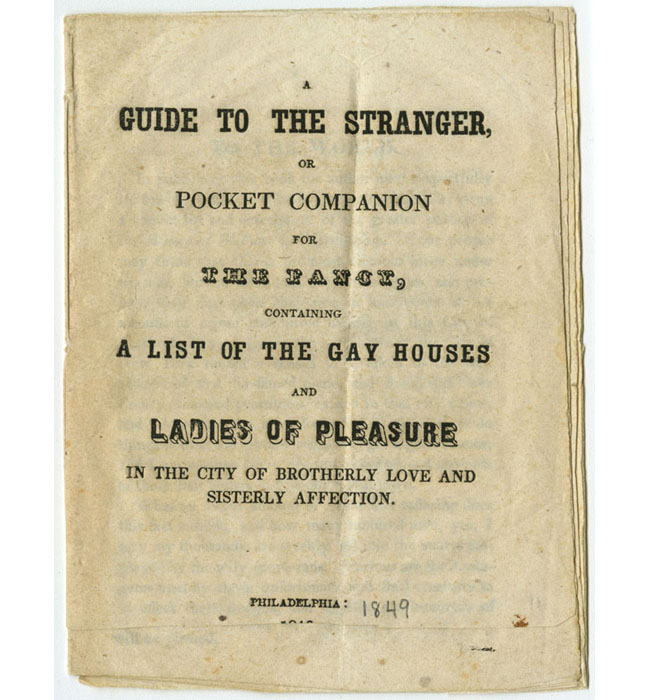
When Wendy Woloson, guest curator of the Library Company’s 2012 Capitalism by Gaslight exhibition, selected an 1849 guidebook to Philadelphia’s seamy underbelly—A Guide to the Stranger —to exhibit, she may not have realized how much attention it would get.  
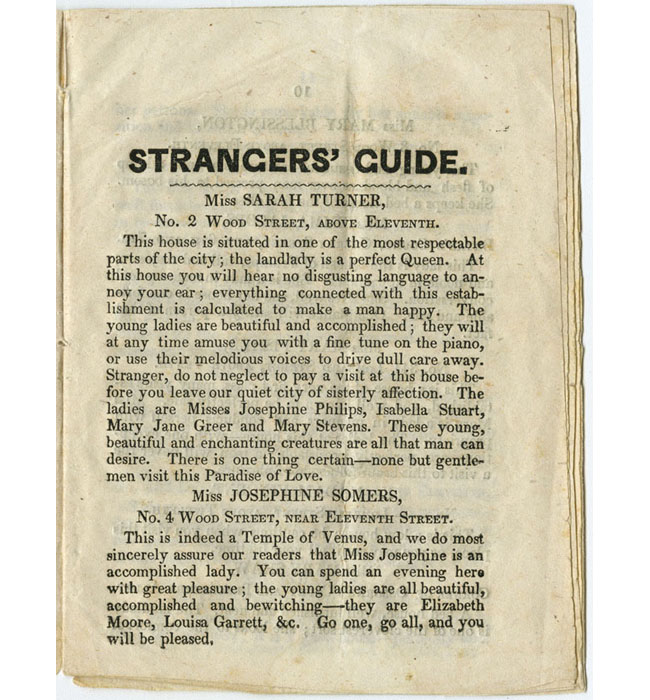
Subtitled Pocket Companion for the Fancy, Containing a List of the Gay Houses and Ladies of Pleasure in the City of Brotherly Love and Sisterly Affection, the guide was intended for men visiting Philadelphia.  It helpfully provides the locations and descriptions of the city’s brothels and rates the prostitutes who work in each. 
Once the exhibition was put on line in September, the Guide was featured in Slate.com’s history blog, the Vault and received recognition on PhillyNow.com.  Philadelphia Magazine went so far as to post current photographic views of some of the spicier locations mentioned in the guide.

In December, the Philadelphia Daily News followed up with an interview of Curator of Printed Books Rachel D’Agostino about the Guide, the related items in our collections, and the ways the volume was distributed, understood, and used by contemporaries.  Read the complete text of the article.

Friday, November 14, 2014

“Genius of Freedom “ Opens


On November 11, the Library Company unveiled our newest exhibition, which documents African American political and social activism in the North in the decades after Emancipation.  “The Genius of Freedom: Northern Black Activism and Uplift after the Civil War,” Curator of African American History Krystal Appiah’s first major exhibition since joining the Library Company in 2012, will run through June 26, 2015. Collection materials on display include rare documents from nineteenth-century Colored Conventions, political activism and civil rights organizing across the North, and movements to reclaim history and instill racial pride, “Genius of Freedom” turns the spotlight on the relatively less-studied Northern States in the period of Reconstruction.


The end of the Civil War and the subsequent abolition of Southern slavery were a source of jubilation for African Americans throughout the United States. Black activists and their white allies were instrumental in the passage of federal laws that expanded civil rights for African Americans. African Americans in the North, however, learned that local laws and social customs often still left them on the fringes of citizenship and success. As a result, Northern blacks sought to empower their communities through political protest and uplift initiatives that emphasized equality, self-reliance, and pride.


As the 19th century progressed, the domestic parlor became an increasingly important symbol of middle-class respectability in the US.  African Americans in the North expressed racial pride and celebrated their new citizenship status by decorating their homes with inspirational pictures and texts of black life and accomplishments. Visit the exhibition to view large-scale lithographs of black political and social leaders and editions of the first histories of the contributions made by Americans of African descent written by black people, among the many other documents of the struggles and triumphs of Reconstruction.


At the opening reception,  Dr. Kali N. Gross of the University of Texas, Austin, gave a talk entitled "Race, Sex, and Criminal Economies in Turn-of-the-Century Philadelphia," which looked at the socioeconomic backdrop to expressions of crime, sex, and violence by black women to propose that they may sometimes have been unique opportunities to exercise agency.  A former fellow at the Library Company, Dr. Gross is the author of Colored Amazons: Crime, Violence, and Black Women in the City of Brotherly Love, 1880-1910.

Librarian Jim Green Talks Junto


In September 2013 Geoff DiMasi, principal at the South Philadelphia web design firm P’unk Avenue, organized a two-day meeting that he called the Junto Retreat.  According its website, it was “a place for business leaders to talk about how to make a positive impact.”  Afterwards Geoff said, “While they were interested in personal improvement, there was also this idea of making the city and the places they lived, the community they lived in, a better place."  The common bond for those gathered, he said, was an affinity for "ideas like 'for profit, for good' or 'not-just-for-profit' business models."  It was a big success, and he promised to hold a second Junto Retreat this year.


Geoff and the other organizers were of course modeling their Junto on Franklin’s “Club for Mutual Improvement,” which first met in the fall of 1727, so this year they decided to begin their 2014 meeting with some background on the original Junto.  Years before, Geoff was an MFA student in the Book Arts Program at the University of the Arts, where he took a course at the Library Company on the history of the book taught by Librarian Jim Green.  The class always began with a little talk about the Junto, so Geoff asked Jim to do something like that for his group.


And so it was on a rainy Saturday in September, Jim found himself standing just under the pulpit at historic Christ Church, only a few feet from Franklin’s pew, preaching Franklin’s secular gospel of doing well by doing good to the fifty or so participants of the second Junto Retreat.  The burden of his talk was simply that the Library Company, which was a direct outgrowth of the Junto, was the first American voluntary association, and thus the progenitor of thousands of other ad hoc community and social groups.  In 1835, Alexis de Tocqueville wrote in Democracy in America, “Americans make associations to give entertainments, to found seminaries, to build inns, to construct churches, to diffuse books, to send missionaries to the antipodes; in this manner they found hospitals, prisons, and schools. If it is proposed to inculcate some truth or to foster some feeling by the encouragement of a great example, they form a society. Wherever at the head of some new undertaking you see the government in France, or a man of rank in England, in the United States you will be sure to find an association.”  Voluntary associations were then and still are a unique feature of American life, and all of them carry the DNA of the Library Company.  

See page 3 at this link for lots of good pictures.

LCP News Menu