Tuesday, September 22, 2015

A 19th-Century Philadelphian in Rome


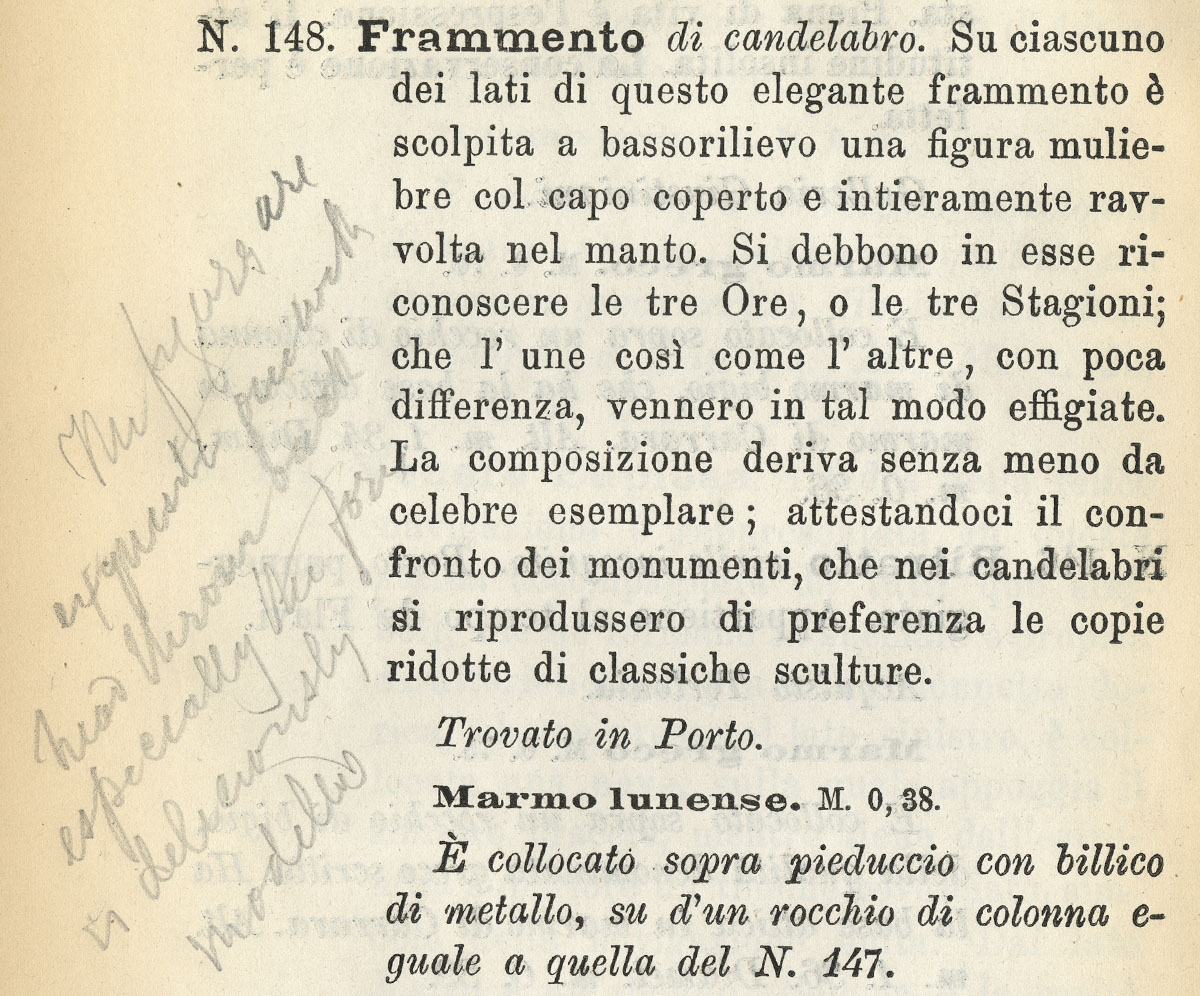
Catalogue of the Museo Torlonia (1876) and detail from p. 78.

The papal visit to Philadelphia reminded us of the Library Company’s extensive Anne Hampton Brewster Collection. Miss Brewster (1819-1892) left her books and personal papers to the Library Company as a bequest. She converted to Catholicism at age 30, while still living in Philadelphia. Eventually she settled in Rome. As part of her work as a foreign correspondent for American newspapers, she carefully negotiated relations with papal leaders.

A lifelong student of Italian history, culture, and especially art, Brewster had wide-ranging interests. Consequently, the research-potential of the Brewster Collection is also wide-ranging. For example, earlier this month, former fellow Dr. Etta Madden spoke in Bagni di Lucca, Tuscany, on Brewster’s professional labors there in 1873 and her relationship with Rodolfo Lanciani, a key figure in the excavation of Roman sites after the unification of Italy. Late that summer Brewster wrote accounts of the region for the Boston Daily Advertiser and translated one of Lanciani’s books.

During her fellowship, Dr. Madden brought our attention to the many annotations in the books in Brewster’s library. Shown here is Brewster’s copy of the guide to the Museo Torlonia, the Torlonia family’s collection of classical antiquities. The Torlonias worked closely with the Vatican, and even today members of the family have hereditary honors at the Vatican. Dr. Madden has noted that Brewster’s article on the museum appeared in Blackwood's (July 1879). Previously one of her newspaper articles had appeared describing a visit to the museum: “I went . . . one beautiful May afternoon, and spent more than three hours, looking, making notes, and taking in impressions so rapidly that I grew giddy” (Boston Daily Advertiser, June 19, 1877).

We deciphered the marginal note shown here: “The figures [on a fragment of a candlestick] are exquisite – one with head thrown back especially – the form is deliciously modelled.” Brewster presumably wrote that annotation on the beautiful May afternoon she described for Boston readers. We hope further study will bring more attention to Brewster’s role in the dissemination of information on Italy, Italian culture, and art appreciation to English speakers during this significant period in Italian history.

“That’s So Gay” (the online version) – Launched

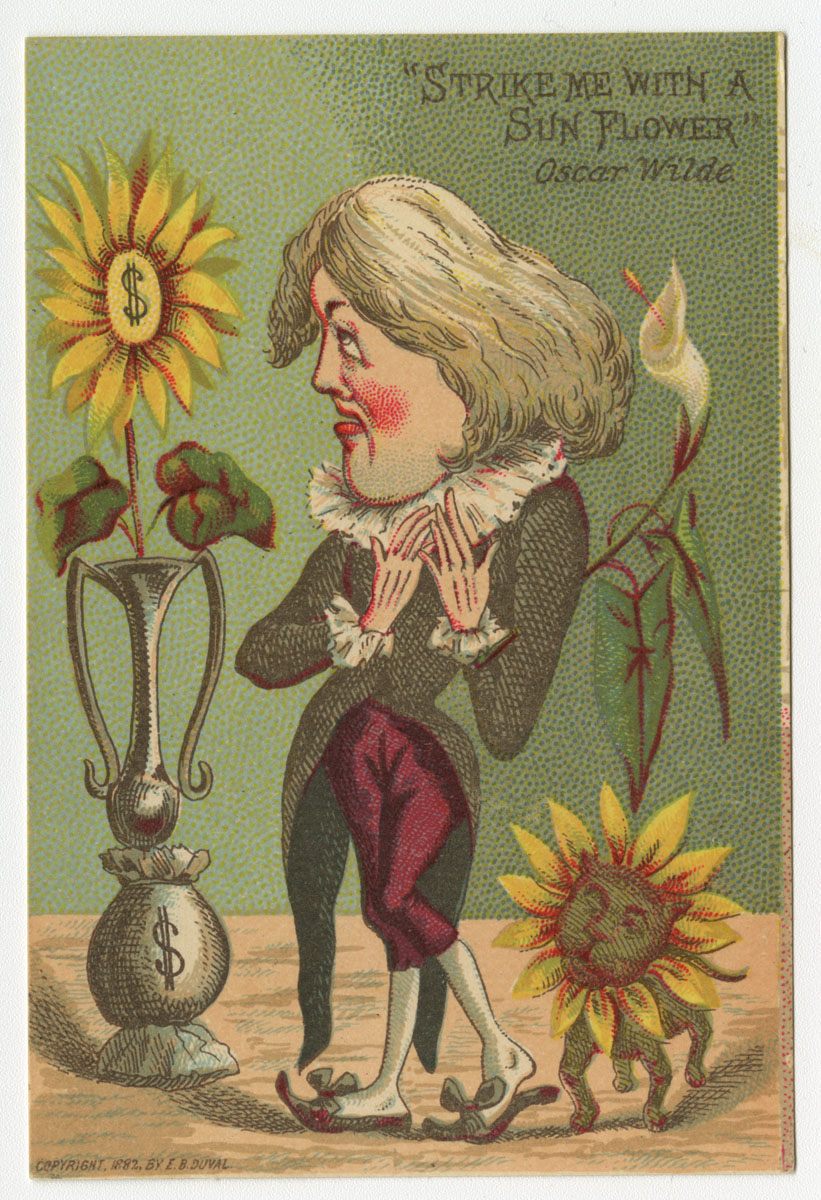
Trade card showing influence of Oscar Wilde’s 1882 tour of North America.

This month, we transformed the 2014 exhibition “That’s So Gay: Outing Early America” into an online resource: www.gayatlcp.org. We’ll be counting the hits on the website in October (LGBT History Month). Please help us boost the numbers. Hint: Sharing it with your friends online would be a great way to celebrate Oscar Wilde’s birthday on October 16.

The project began in November 2012, when representatives from the William Way LGBT Community Center approached the Library Company as a possible venue for an exhibition on Philadelphia gay rights activism, 1965-2015. Since the Library Company’s collections don’t support that topic, we offered to do the prequel instead, and thus “That’s So Gay” was born.

Also, do consider stopping by the National Constitution Center to see “Speaking Out for Equality, 1965-2015,” which is on view through January 3, 2016.

Monday, July 20, 2015

Fashioning Philadelphia – The Style of the City, 1720-1940


The Library Company of Philadelphia presents over 200 years of fashion history in its newest exhibition, which opened July 20. Fashioning Philadelphia – The Style of the City, 1720-1940 tells the largely unheralded story of Philadelphia’s contributions to the early fashion industry. Curated by Wendy Woloson (Assistant Professor of History, Rutgers University), Fashioning Philadelphia features prints, photographs, books, ephemera, and artifacts from the Library Company's premier collection of historical materials. The exhibition is on view through March 4, 2016.

The exhibition highlights Philadelphia's many important contributions to making clothing and shaping style over two centuries, which have largely been forgotten today. Home to modest Quakers, prosperous free blacks, well-heeled international transplants, and working classes of all sorts, Philadelphia was America's most cosmopolitan city from the late 18th through the 19th century. Chestnut Street in particular enjoyed a reputation for being as fashionable as the grand thoroughfares of Paris and London. In addition, Philadelphia was a manufacturing powerhouse that supported industries producing textiles, leather goods, and accessories. The city was also a major publishing center – women's magazines such as Godey's Lady's Book helped shape popular fashions and then disseminate them throughout the country. Philadelphia retailers, including Wanamaker and Strawbridge & Clothier, erected lavish department stores – dream palaces of consumption – in the heart of the city.

To tell this particular story, Fashioning Philadelphia draws on the Library Company's rich collections of historical materials. Among many other items, it includes several portraits of Benjamin Franklin ("Philadelphia's first fashionista"), hand-colored fashion plates showing men and women wearing the latest styles, tailoring patterns, contemporary views of Chestnut Street, interior views of the Stetson hat factory, architectural renderings of major department stores, and small artifacts such as 19th-century sunglasses and ladies' boots.

By showing depictions of Philadelphians from all walks of life, from prosperous free African Americans to the laboring poor, gang members to Quakers, the exhibition also presents a social history of the city, and of urban America in general, as it changed over two centuries.


Fashioning Philadelphia – The Style of the City, 1720-1940 is free and open to the public, July 20, 2015 – March 4, 2016, Monday - Friday, 9 am to 4:45 pm. The exhibition and its accompanying programming are supported by funds from the Dolfinger-McMahon Foundation.  For the latest events associated with this exhibition, visit librarycompany.org/events.

LCP News Menu