There is an element of magic in the creation of a lithographic print. The process is based on a simple principle familiar to any cook or observer of urban mud puddles – oil and water do not mix. However, in practice there is nothing straightforward about the process. The production of the intricately detailed and textured 19th-century lithographs in the Library Company’s holdings required considerable skill and intuition on the part of lithographic artists and printers.
In early February, Library Company staff members and volunteers visited the lithographic printing studio of Deer Tree Press in the Crane Arts Building to observe a demonstration of the process by proprietor and local printer Elizabeth Gross. Ms. Gross trained at the Tamarind Institute, a premier center for fine art lithography at the University of New Mexico, as well as at the Pennsylvania Academy of the Fine Arts and the University of the Arts. She skillfully led the staff through the process of graining the large slabs of limestone that serve as the printing surface; drawing on the stone with a variety of greasy crayons and inks; chemically treating the surface of the stone to increase the adherence of the printing ink to the drawing while allowing the remaining parts of the wetted stone to reject the ink; and, finally, printing the images on the press.
The demonstrations were organized as part of the Library Company’s 19th-century lithography research project, “Philadelphia on Stone,” which seeks to promote the greater understanding and appreciation of early commercial lithography. More information about “Philadelphia on Stone” is available at http://www.librarycompany.org/collections/prints/stone.htm or visit the press at www.eagross.com.

Saturday, May 3, 2008

Tuesday, April 3, 2007
New Grant Funds Library Company’s Exploration of Philadelphia’s Colorful Past
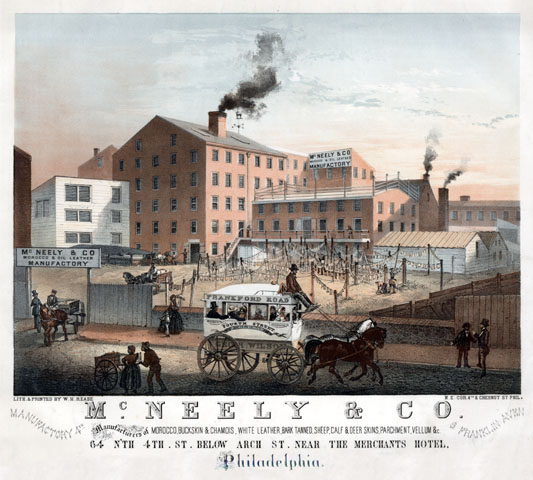 Long before circulars jammed our mailboxes and glossy advertisements for every department store in the city came sliding out of the Sunday paper, lithography was the word—and the image—on the street. Invented in the late 1700s, lithography transformed the iconography of Philadelphia (and our entire nation) as a new process that used large slabs of limestone as the printing surface. It made possible the cost-effective use of color and allowed designers to easily combine text and images. Our contemporary visual culture has its roots in early tickets, letterhead, forms, circulars, and—most importantly—advertisements.
 Printed by W.H. Rease, ca. 1860. The caption reads, "McNeely & Co. manufacturers of morocco, buckskin & chamois, white leather, bark tanned, sheep, calf & deer skins, parchment, vellum &c. 64 N. 4th. St. below Arch St. near the Merchants Hotel, Philadelphia." The McNeely family operated a leather manufactory in Philadelphia from 1830 until the early 20th century.
The Library Company of Philadelphia has received a three-year grant from the William Penn Foundation toward Philadelphia on Stone: the First Fifty Years of Lithography, which will explore the work of Philadelphia’s 19th-century lithographic artists and printers. Despite increased scholarship in recent years, this is the one of a few studies of commercial lithography as practiced in one city. The project includes plans for a digital catalogue of more than 800 lithographic views of Philadelphia, an illustrated biographical dictionary of early commercial lithographers, a collection of essays, and a public exhibition.
The images tend to have broad appeal because they provide richly detailed depictions of Philadelphia street scenes, commercial life, and architecture,” says Jennifer Ambrose, Associate Curator of Prints & Photographs at the Library Company and director of the project. “We think anyone interested in the city’s past, as well as professionals like scholars and graphic artists, will find these images relevant and compelling.” Those interested in the development of American consumer culture will also appreciate these images that are foundational to the modern advertising industry.
As Philadelphia made the radical transition from seaport to manufacturing center, store owners often commissioned lithographic views that showcased window displays of merchandise, new architectural features, and signage. Shoppers, pedestrians, street vendors, errand boys, and every type of vehicle are part of lively street scenes that are beautiful in their detail. In these images, lithographers preserved the colorful images of daily life in the 19th century—including depictions of women, African-Americans and working-class laborers who were often excluded from traditional portraiture.
The digital catalogue of lithographs will be a free, openly-accessible resource for print curators, collectors, genealogists, and historians. Several views are already available online in the Wainwright collection of ImPAC, an image database accessible through the Library Company’s website. While the Library Company holds the largest collection of Philadelphia scenes by local firms from the early decades of commercial lithography, the catalogue will also include images surveyed and scanned from the collections of institutions throughout the region. The final exhibition will coincide with Philagrafika 2010, an international art quadrennial focused on the role of the printed image in shaping contemporary visual culture around the globe.
The Library Company’s Print & Photographic Department specializes in 19th-century depictions of Philadelphia and works by regional artists. Free and open to the public, the Library Company of Philadelphia—founded by Benjamin Franklin in 1731—is an independent research library concentrating on American society and culture from the 17th through 19th centuries. The Library Company’s mission is to preserve, interpret, make available, and augment an extensive non-circulating collection of rare books, manuscripts, broadsides, ephemera, and works of art.
Saturday, February 3, 2007
Afro-American Exhibit at Swann Auction Galleries
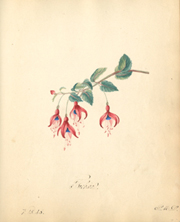
The 13 items on display, selected by Curator of Afro-Americana Phil Lapsansky, include books, pamphlets, broadsides, manuscripts and art works acquired from the earliest years of the Library Company up to recent gifts and purchase. Blacks represented in the exhibit include Phillis Wheatley, Frederick Douglass, Benjamin Banneker, David Walker, Jean Jacques Dessalines, Nat Turner, Robert Douglass, Jr., and Sarah Mapps Douglass. Our thanks to Swann Galleries for this opportunity to make our collection better known to their many discerning and knowledgeable patrons.
Top left: "Fuchsias," by the African American educator and antislavery activist Sarah Mapps-Douglass,personal album of Mary Anne Dickerson.
 |
| Library Company Board President Bea Garvan and Caroline Birenbaum of Swann Galleries |
click here.
For more information about Swann Auction Galleries’ new African-American fine art collection,
click here.
Subscribe to:
Posts (Atom)
Subscribe To


 Posts
All Comments
Posts
All Comments